Contact Form
Search




If you want a dump truck that truly fits your job, stop focusing only on “length × width × height”. What matters more is how these dimensions affect your site access, your load stability, and your operating cost. Size is not just a number; it is the difference between finishing a job smoothly or wasting hours maneuvering a truck that is too big or too small for your site.
This guide helps you understand dump truck dimensions in a way that directly connects to your real-world use cases, not just textbook specs.
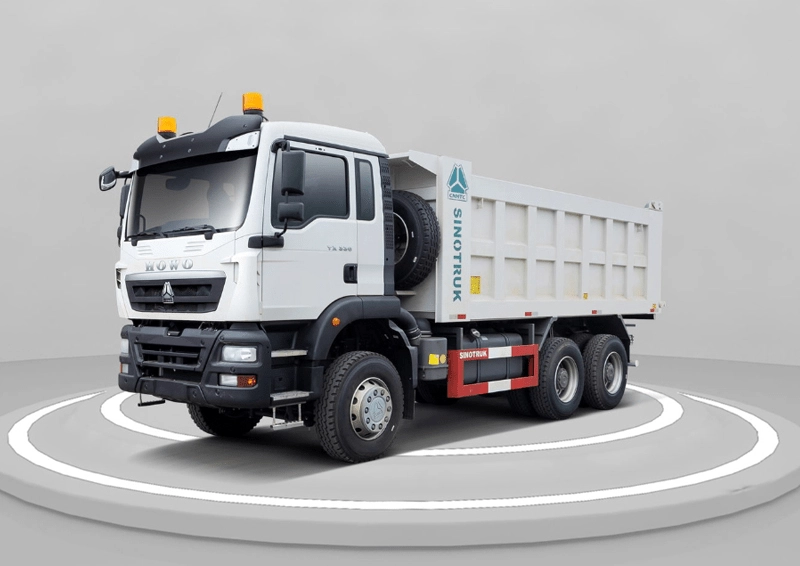
Most dimension guides simply list numbers. The problem is: numbers alone cannot tell you how the truck behaves when working in tight construction zones, soft soil, steep slopes, or urban streets.
A dump truck is like a pair of safety shoes: the size label is important, but comfort, flexibility, and suitability matter more. The same applies to truck dimensions.
You will understand the truck better when you see how each dimension influences turning radius, payload stability, fuel cost, and operator convenience.
Typical range: 7.0–11.0 m
What it means for you:
A longer truck carries more but needs more space to turn. If your jobsite has narrow gates, soft shoulders, or steep ramps, a shorter wheelbase is often safer and faster.
Typical range: 2.3–2.55 m
What it means for you:
Most buyers check width only for road compliance, but it also affects how confidently you can reverse into a loading zone. If your job involves frequent tight backing maneuvers, even a 10 cm difference will feel like a big upgrade.
Typical range: 3.0–3.8 m
What it means for you:
Height determines:
– Whether you can pass under pipes and low beams
– How stable the truck is when the box is raised
– How much soil may fall back when unloading on windy days
Higher is not always better. Many buyers learn this only after their first “near-tip-over moment” on uneven ground.
Typical range: 3.2–4.5 m
If payload is the “muscle”, wheelbase is the “balance”.
Shorter wheelbase = quicker turns
Longer wheelbase = smoother, more stable rides
Common internal lengths: 4.5–7.0 m
Common internal widths: 2.2–2.4 m
Common heights: 1.0–1.6 m
What matters is matching the box size with your loading equipment.
If your loader’s bucket is 2.7 m wide, a 2.3 m box requires more precision and time. A box that fits your bucket width saves hours over a long project.
Usually used for construction, sand, gravel, urban work
Typical size:
– Length: 7.5–9.0 m
– Width: 2.4–2.55 m
– Height: 3.0–3.4 m
Strong on short-distance cycles, fast unloading, easy to maneuver.
Used for ore, large stone, mining pits
Typical size:
– Length: 9.0–11.0 m
– Width: 3.0–3.5 m
– Height: 3.5–3.9 m
Excellent for massive payloads, not suitable for narrow jobsites.
Often used in off-road construction, muddy and steep sites
Typical size:
– Length: 9.0–11.2 m
– Width: 2.9–3.1 m
– Height: 3.2–3.6 m
The articulation joint gives you turning agility that rigid trucks cannot match.
Many guides focus on payload first. But in real projects, your jobsite access limits your dimension choices more than your material volume.
If your site cannot accommodate an 11-m truck, payload advantages are meaningless because the truck will simply not enter safely.
This is why selecting by “bigger is better” leads to unnecessary delays, fuel waste, and turning damage.
Choose:
– Length under 8.5 m
– Wheelbase under 3.8 m
– Width 2.3–2.4 m
Choose:
– Length 9–10 m
– Box length 5.5–6.5 m
– Higher box height (1.4–1.6 m)
Choose:
– Wider trucks (2.9–3.3 m)
– High-strength boxes with higher side walls
– Longer wheelbase for stability
Focus on:
– Lower center of gravity
– Moderate height
– Stronger rear suspension
Think of the truck like a tool: the correct size makes your daily work lighter and safer.
| Type | Length | Width | Height | Best for |
|---|---|---|---|---|
| Standard dump | 7.5–9 m | 2.4–2.55 m | 3.0–3.4 m | Urban, sand, gravel |
| Heavy-duty dump | 9–11 m | 3.0–3.5 m | 3.5–3.9 m | Mining, heavy rock |
| Articulated dump | 9–11.2 m | 2.9–3.1 m | 3.2–3.6 m | Off-road, slopes |
Overall length, because it directly affects turning radius and jobsite access.
No. Higher boxes increase center of gravity and risk of tipping, especially on uneven ground.
Yes. Most manufacturers allow custom box height, width, and thickness to match your loader and material type.
Not necessarily. Payload depends more on box volume and chassis rating than width alone.
© 2025 SINOTRUK. Privacy Policy | Warranty Policy
Address: No. 777 Huaao Road, Innovation Zone, Jinan, Shandong Province, China






 English
  French
  Spanish
  Portuguese
  Arabic