Contact Form
Search




Choose an end dump if you need maximum dumping height, want to unload in uneven areas, or often deliver to construction sites with limited space.
Choose a bottom dump if you want smooth spreading on the move, operate mostly on stable ground, and care about fast, repeatable unloading cycles.
Your jobsite, not the trailer type itself, decides which one works better for you.
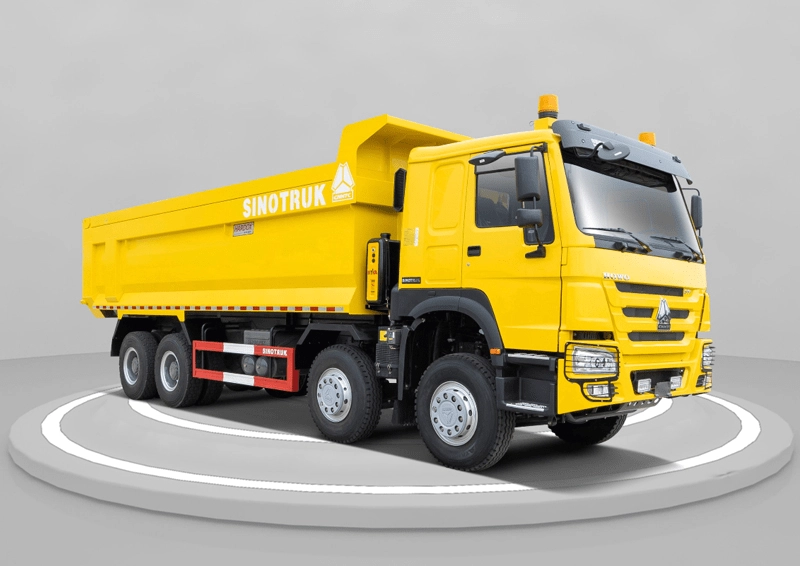
Most guides compare “hydraulic lift vs gate opening.
But that does not tell you whether your driver will struggle to unload on a slope, or whether your project manager will waste time reshaping dumped material after every cycle.
You care about:
– How your loader and truck coordinate
– How much space you have
– How quickly your crew needs material delivered
– Whether one small mistake can stop the whole operation
That is why this guide takes a workflow-based angle rather than a mechanical one.
An end dump lifts its box upward and unloads from the back.
Think of it like tipping a wheelbarrow: all the material falls out in one pile.
– Works even in uneven or rough ground
– More flexible for construction sites
– Can dump higher piles (helpful for stockpiling)
– Needs more caution because of the raised bed
– Unloading area must be clear behind the truck
End dumps suit you if your unloading points change often or are unpredictable.
A bottom dump opens its gates under the trailer.
Material drops straight down while the truck can keep moving.
Like pouring sand by cutting open a bag from the bottom while walking forward.
– Perfect for spreading material evenly
– Faster cycles because no lifting
– Great for road building and long, straight workzones
– Needs a flat, stable ground to operate safely
– Not ideal when you need a tall pile in one location
Bottom dumps suit you if your work is repetitive, linear, and efficiency-focused.
– End dump: better for tight spaces
– Bottom dump: better for open and long sites
If your projects involve alleys, villages, or small yards, you will appreciate the end dump.
– End dump: precise but vertical
– Bottom dump: perfect for smooth spreading
If you build roads, a bottom dump saves huge shaping time.
End dump: risk of tipping if the ground is uneven
Bottom dump: safer unloads but requires stable ground
You choose based on the condition of your jobsite, not the design of the trailer.
– Bottom dump: generally faster
– End dump: depends on how high you lift and how much space you have
When you run many trips per day, cycle speed can decide your total project cost.
End dump: good for piling
Bottom dump: good for uniform layers
Different projects, different materials, different needs.
Choose an end dump if:
– Your jobsite is uneven
– You need high piles
– You deliver to many different locations in one day
– You handle material that needs controlled placement
– Space is tight and you cannot drive through while unloading
This is the more flexible, more “go anywhere” choice.
Choose a bottom dump if:
– You build roads or long ground layers
– Your unloading area is wide and flat
– You want the fastest cycles
– You need material spread over distance, not piled
– You want to reduce loader work after dumping
This is the high-efficiency, production-focused choice.
End dump = pouring a bucket in one place.
Bottom dump = spreading rice along a path while walking.
Your project will tell you which one fits.
If your work changes daily, choose end dump.
If your work repeats in a long line, choose bottom dump.
You save more time by matching the trailer to your work pattern than by choosing based on specs alone.
It can move on uneven roads, but it should unload only on stable, level ground.
Not always. They are safe when used correctly, but the raised bed requires attention.
Bottom dumps usually require fewer movements and shorter unload time, which can reduce fuel use.
Yes. The driving is similar, but unloading habits are different.
© 2025 SINOTRUK. Privacy Policy | Warranty Policy
Address: No. 777 Huaao Road, Innovation Zone, Jinan, Shandong Province, China






 English
  French
  Spanish
  Portuguese
  Arabic