Contact Form
Search




If your main goal is flexibility and turning convenience in tight spaces, you will usually prefer a semi trailer. If your goal is maximum cargo capacity with stable straight-line driving, you will usually prefer a full trailer.
The right choice depends less on the trailer itself and more on your roads, your loading habits, and your daily transport patterns.
Many explanations focus on mechanical structure only. But as a buyer or operator, you care more about how the trailer behaves in your real world.
Choosing between a full trailer and a semi trailer is like choosing between a backpack and a suitcase. Both carry things, but what matters is where you take them, how often you move them, and how easily you can handle them.
You want a comparison that answers practical questions, not just engineering terms.
That is the angle this guide uses.
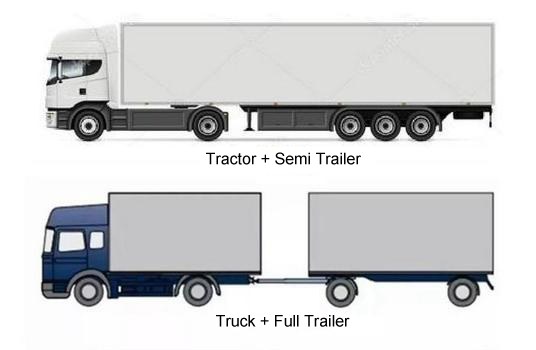
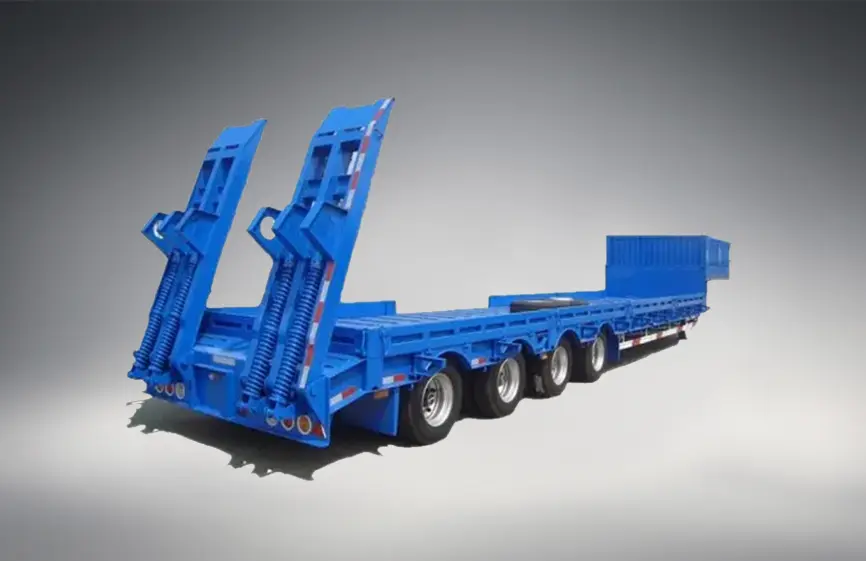
A semi trailer carries part of its weight on the tractor head.
This is why it feels more like an extension of your truck, not a separate vehicle.
– Easier turning because the pivot is close to the tractor
– Better for cities, ports, and mixed routes
– Faster loading/unloading cycles if you switch trailers often
– More stable when you maneuver in tight yards
Semi trailers work well when you want one truck to handle multiple trailer tasks throughout the day.
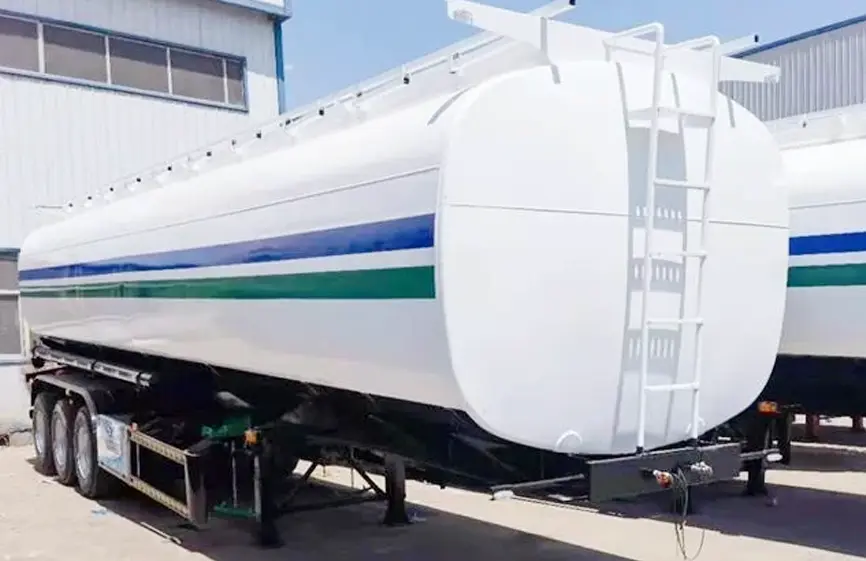
A full trailer carries its weight on its own axles.
It connects to your truck through a drawbar instead of resting on the tractor.
– Bigger total cargo capacity
– Very stable on long straight highways
– Works well when you travel fixed, repeated routes
– Can operate like a “train”, especially when paired with another unit
A full trailer is better when you value volume over maneuverability.
Most guides simply say:
“semi trailer = part load on truck; full trailer = independent load.”
But this does not tell you whether the trailer will get stuck in your warehouse gate, or whether your driver will struggle to reverse into a loading point.
Here is the comparison that matters for operations:
– Semi trailer: small, very flexible
– Full trailer: larger, especially when reversing
If your jobsite has tight curves, the semi trailer saves you time and reduces stress.
– Full trailer: usually higher total capacity
– Semi trailer: moderate, but enough for most general cargo
If your business is agricultural products, beverages, or consumer goods, the extra volume of a full trailer can be a big advantage.
– Full trailer: excellent
– Semi trailer: good
Long-distance highway transport benefits more from a full trailer.
– Semi trailer: easier
– Full trailer: requires more skill
Many operators underestimate this until they face it on a busy workday.
– Semi trailer: easier to swap tractors
– Full trailer: needs matching drawbar configuration
Choose a semi trailer if you have:
– Narrow urban roads
– Many delivery points
– Multiple trailer types for one tractor
– Frequent coupling/uncoupling
– A need to turn quickly inside ports or construction areas
Think of it as the “all-round” solution that keeps your operations flexible.
Choose a full trailer if you have:
– Long-distance highway transport
– High-volume cargo
– A fixed logistics route
– Large warehouses or open loading areas
– A priority for lower cost per ton-km
This is usually the best option if you want the highest total load while keeping transport predictable and stable.
A semi trailer is like a delivery van:
easy to turn, good for city and mixed routes.
A full trailer is like a cargo train carriage:
huge capacity, excellent stability, best for predictable routes.
If your daily routes feel tight, unpredictable, or involve many stops, choose semi trailer.
If your focus is maximum load and long-distance highway movement, choose full trailer.
Your roads decide more than your trailer.
Not always, but it usually offers a higher total volume because it stands on its own axles.
Both are safe when matched correctly. Semi trailers feel more stable when turning; full trailers feel more stable in straight lines.
It depends on cargo density. Full trailers carry more per trip, but semi trailers waste less fuel in tight operations.
Not directly. They use different connection structures. Most fleets use both based on route needs.
© 2025 SINOTRUK. Privacy Policy | Warranty Policy
Address: No. 777 Huaao Road, Innovation Zone, Jinan, Shandong Province, China






 English
  French
  Spanish
  Portuguese
  Arabic