Contact Form
Search




There are many tanker trailer types, but most buyers only need to understand one thing first: tanker trailers are classified by what they carry and how the liquid behaves, not by how they look.
If you choose based on appearance or name alone, you are very likely to pick the wrong type. Once you match the tanker type to your cargo behavior, the right choice becomes obvious.
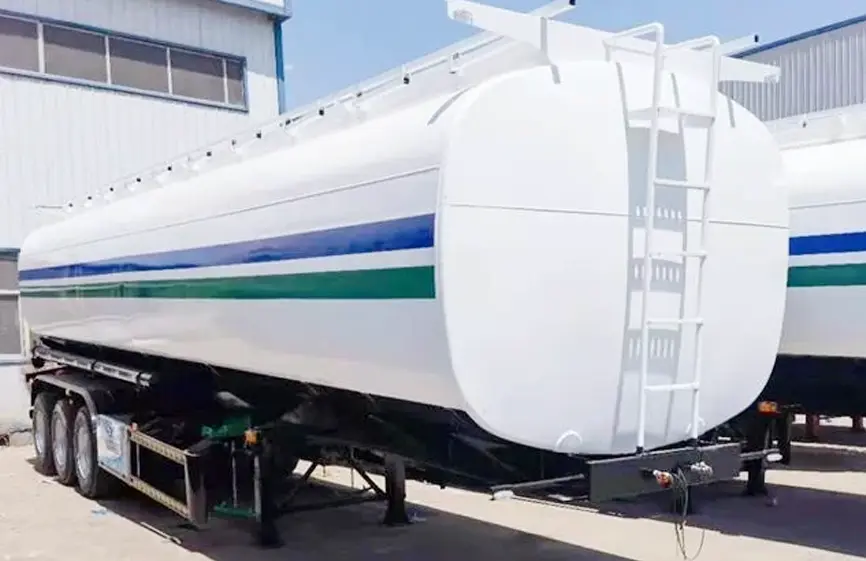
Most articles list tanker types like a catalog. Fuel tanker, chemical tanker, food-grade tanker, water tanker, and so on.
That looks clear, but it hides the real logic.
A tanker trailer is not just a container. It is more like a control system for moving liquids. Liquids shift, surge, expand, and react. Different tanker types exist to control those behaviors safely.
Once you see that, the classification becomes simple.
Instead of memorizing long lists, it is more useful to group tanker trailers by how the liquid behaves inside the tank.
You can think of tanker trailers as falling into four practical categories.
This is the most common category.
These tanker trailers carry liquids that are:
stable
non-reactive
not sensitive to temperature
Typical uses include water, some oils, and certain industrial liquids.
They are often single-compartment or multi-compartment tanks with standard safety equipment. If your cargo behaves calmly, this type usually works well.
Think of it like carrying water in a bottle. You still need a lid, but you do not need special insulation or pressure control.
Fuel tankers look similar to general liquid tankers, but they are built with stricter safety logic.
They usually include:
multiple compartments to reduce liquid surge
anti-static and grounding systems
higher safety standards for valves and fittings
Fuel moves easily and ignites easily. That combination changes everything.
If general liquid tankers are water bottles, fuel tankers are thermos bottles with safety locks.
This is where many buyers underestimate complexity.
Chemical tanker trailers are designed around:
corrosion resistance
temperature control
pressure or vacuum management
Some chemicals attack steel. Others react to air. Some change properties when heated.
That is why chemical tankers may be insulated, lined, or built from special materials. Two chemical tankers can look similar but be completely incompatible with the same cargo.
Choosing the wrong type here is not inefficient. It is dangerous.
Food-grade tankers are not just “clean tankers”.
They are built to:
prevent contamination
allow full drainage
support strict cleaning processes
Milk, edible oil, and liquid food products behave gently, but hygiene requirements are unforgiving.
If chemical tankers focus on resistance, food-grade tankers focus on purity.
Many articles treat compartments as a small detail. In practice, they change how a tanker performs.
More compartments:
reduce liquid surge
improve braking stability
allow mixed cargo loads
Fewer compartments:
increase usable volume
simplify cleaning
reduce weight
There is no “better” option. There is only what fits your operation.
A common assumption is that you should always choose the most specialized tanker available.
That is not always true.
Over-specifying a tanker:
increases cost
limits flexibility
may create unnecessary maintenance issues
Under-specifying a tanker:
risks safety
limits cargo compatibility
may violate regulations
The right tanker type sits in the middle, not at the extremes.
Instead of asking “What tanker types exist?”, ask yourself:
How does my liquid move when braking or turning?
Does it react to temperature or air?
Do regulations treat it as hazardous or food-grade?
Will I carry one product or multiple products?
When you answer these honestly, the correct tanker type usually reveals itself.
Can one tanker trailer handle different liquid types?
Sometimes, but only if materials, cleaning standards, and safety systems match all cargo requirements.
Is a fuel tanker just a chemical tanker with compartments?
No. Fuel tankers follow specific safety standards that general chemical tankers may not meet.
Are food-grade tankers more expensive?
They can be, mainly due to material choice and cleaning requirements.
Does tanker type affect resale value?
Yes. More versatile tanker types usually retain value better in the secondary market.
Tanker trailer types are not about labels. They are about behavior, safety, and control.
Once you understand that, you stop reading endless lists and start making confident decisions.
That is usually the moment when buyers stop searching for “one more article”.
© 2025 SINOTRUK. Privacy Policy | Warranty Policy
Address: No. 777 Huaao Road, Innovation Zone, Jinan, Shandong Province, China







 English
  French
  Spanish
  Portuguese
  Arabic