Contact Form
Search




If you only want one clear conclusion before reading anything else, here it is: your ideal tanker truck size depends far less on “standard dimensions” and far more on how and where you actually plan to operate the truck. Many guides online list fixed lengths or volumes, but in real operations, you decide dimensions based on your roads, loading limits, product density, and safety rules. That is why the smartest buyers compare dimensions backward—from the job to the truck, not the other way around.
Think of it like choosing luggage for a trip. You do not pick a suitcase because “most people use 28-inch luggage.” You pick one that fits your airline rules, your travel days, and what you need to pack. Tanker trucks work exactly the same way.
When you search for tanker sizes, you will often find long tables of numbers—length, width, height, volume, axle spacing. Those numbers are useful, but they can also make you feel unsure whether you are comparing the right things.
Your operations, not general averages, determine the correct dimensions. For example:
Tight inner-city streets may force you to choose a shorter, lighter tanker.
Long-distance fuel hauling on highways may require maximum volume within your legal limits.
Transporting chemicals or asphalt may need thicker walls, which reduces internal volume.
This is why two tankers with similar length can have very different usable capacity.
Below are realistic dimension ranges used in international markets. These ranges avoid “idealized textbook numbers” and are based on common customer requirements.
These are often used for local fuel distribution.
Length: 7–12 m
Width: 2.4–2.6 m
Height: 3.2–3.8 m
Volume: 5,000–20,000 liters (depending on chassis size)
If your routes include gas stations with narrow access, shorter lengths are extremely valuable.
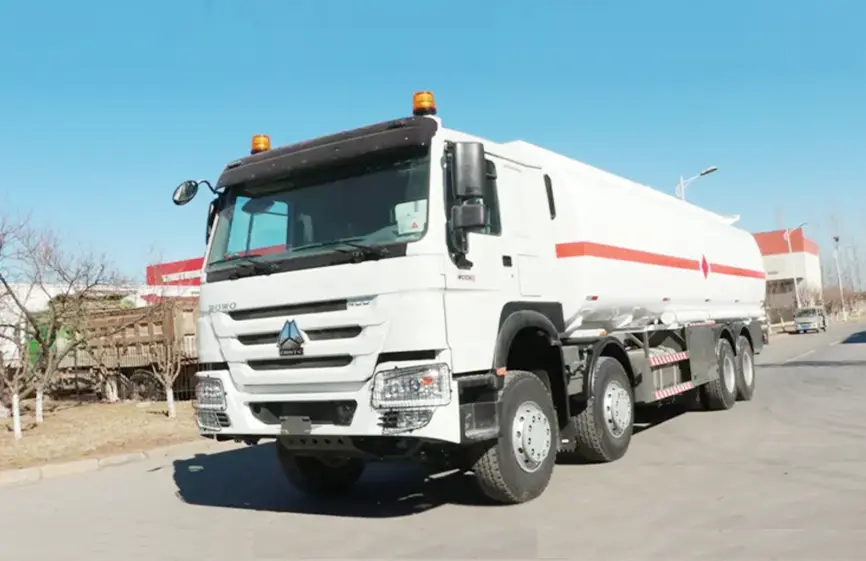
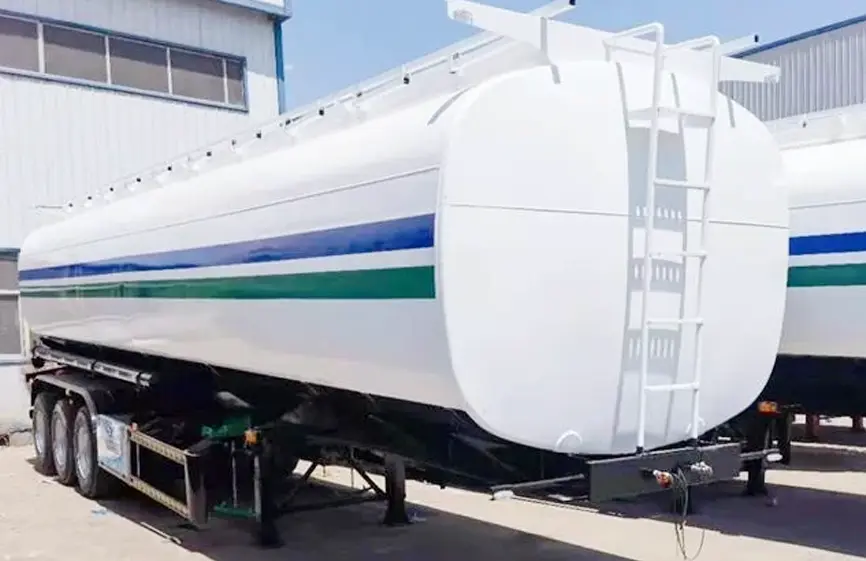
These are widely used for highway transport of gasoline or diesel.
Length: 10.5–13.2 m
Width: 2.5–2.6 m
Height: 3.5–4.0 m
Volume: 30,000–60,000 liters
Some articles online claim all fuel trailers are about the same size, but that is not true. The exact height and length shift depending on compartment numbers, aluminum vs. carbon steel, and road weight limits.
Used for acids, LNG, LPG, alcohol, etc.
Length: 9–13 m
Width: 2.4–2.6 m
Height: 3.2–3.9 m
Volume: 18,000–45,000 liters
Chemicals require special liners or insulation, which affects both the tanker diameter and total height.
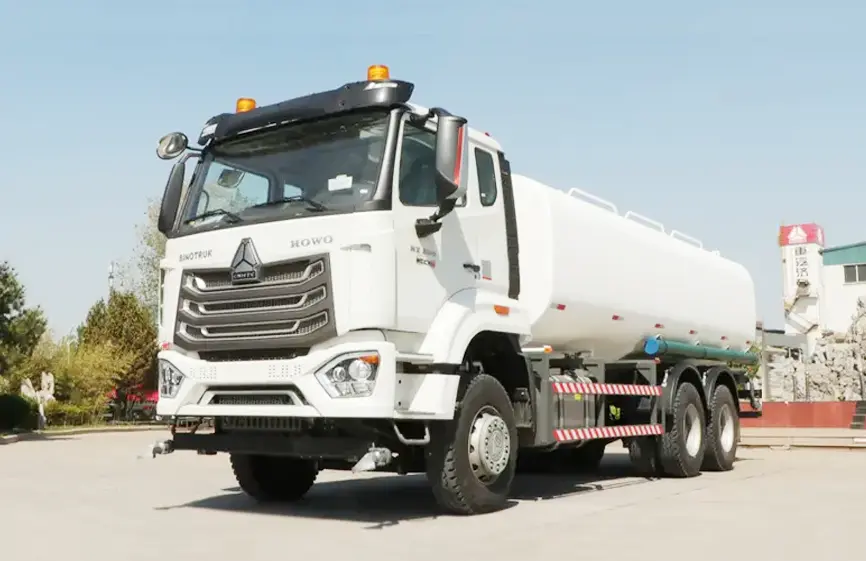
Because water density is fixed, dimensions are more flexible.
Length: 6–11 m
Volume: 5,000–20,000 liters
Water tankers are usually shorter because they serve construction sites or municipal services.
Most articles focus only on length and volume, but weight limits decide what volume you can legally carry.
A 45,000-liter tanker sounds impressive, but if your country limits the gross vehicle weight, you may only load it to 38,000 liters.
You should always check:
Maximum axle load
Maximum gross weight
Allowed overall length
Local bridge or city-zone restrictions
This avoids buying more volume than you can legally use.
To make this simple, use this three-step method:
Start from your product
Fuel, chemical, bitumen, water — each has different density and regulatory requirements.
Match your roads
Tight corners, hilly regions, or long highway routes all require different turning radius and length.
Confirm legal limits
The highest mistake buyers make is assuming all regions share the same limits.
Once you decide these three factors, the “right dimensions” become obvious.
If you work with my team, we usually ask about your delivery routes first—because the best tanker is the one that completes your daily work easily, not the one with the highest advertised capacity.
No. Dimensions vary by country, product type, and road regulations.
Wall thickness, tank diameter, and number of compartments all change the external height.
Not always. Some tankers are long but narrow, especially in regions with strict height limits.
The safest size is the one that matches your legal limits and ensures stable braking and handling on your roads.
Yes. In fact, many of our overseas clients request customized lengths or compartment configurations tailored to their local regulations.
© 2025 SINOTRUK. Privacy Policy | Warranty Policy
Address: No. 777 Huaao Road, Innovation Zone, Jinan, Shandong Province, China







 English
  French
  Spanish
  Portuguese
  Arabic